Elise Wagner: Ancient materials, contemporary abstraction.
Elise Wagner and the Material Language of Encaustic Collagraph
For more than three decades, Elise Wagner has explored the luminous possibilities of encaustic painting — building layered surfaces from beeswax, damar resin, and pigment. Less widely discussed, but equally significant, is her contribution to contemporary printmaking. Through the development of encaustic collagraph, Wagner extends her painting practice into works on paper that retain the same sensitivity to surface, translucency, and structure.
In her hands, wax becomes not only a painting medium, but a printable matrix.
Wax as Matrix
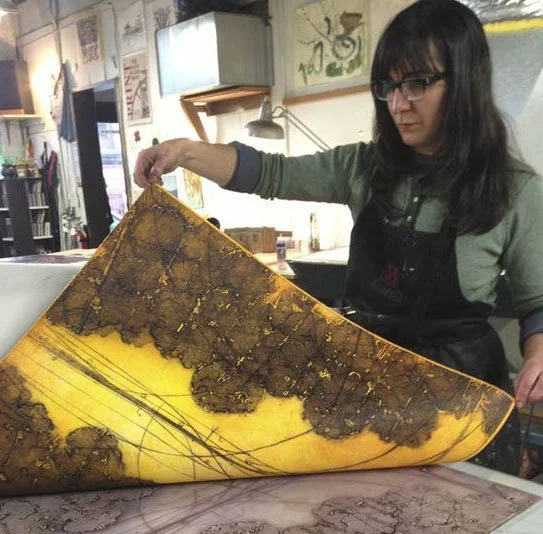
Traditional collagraph plates are constructed from layered materials — paper, fabric, glue — sealed and inked before being run through an etching press. Wagner’s innovation lies in replacing many of those materials with encaustic wax itself.
By carefully refining the ratio of beeswax to damar resin, she created a surface firm enough to withstand the pressure of the press, yet flexible enough to incise and texture. Wax behaves differently from wood glue or acrylic mediums. It can be carved while warm, reheated, and reworked. Lines may be cut directly into the surface. Fabrics can be pressed into it. Subtle relief passages can be built and adjusted.
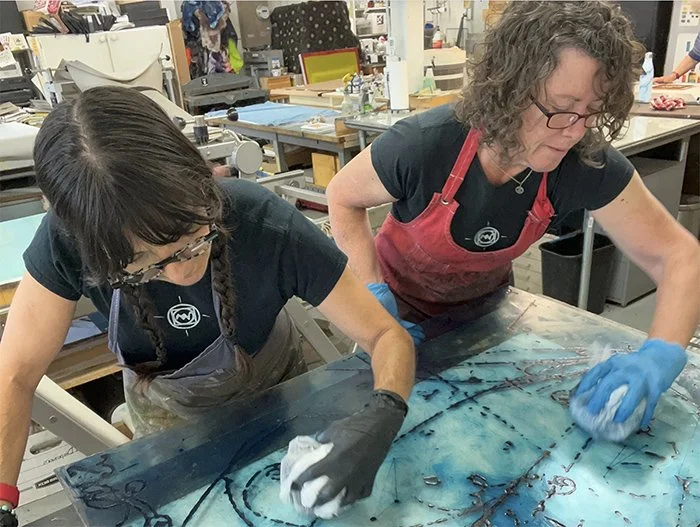
When inked and wiped using soy-based intaglio inks compatible with wax, the plate reveals remarkable tonal depth. Ink settles into incised channels while raised areas can be selectively cleared. The paper records pressure, producing slight embossment that becomes part of the composition.
The result is neither purely relief nor strictly intaglio, but a hybrid surface — tactile, layered, and materially present.
Material Intelligence
What makes Wagner’s encaustic collagraph work compelling is not novelty alone, but material intelligence. Her decades of experience with wax as a painting medium inform every stage of the print process.
Encaustic is inherently transformative: heat liquefies solidity; pigment suspends within translucency; surface records gesture. By adapting wax into a collagraph matrix, Wagner extends those qualities rather than abandoning them.
The press introduces another variable — pressure. Ink is driven into incision. Paper yields to relief. The plate transfers not just image, but physical memory of its making.
Because wax remains responsive, subtle variations can occur between impressions. Structure provides continuity, yet each print retains a sense of immediacy. This balance between control and unpredictability parallels Wagner’s broader practice.
Integration of Painting and Print
Wagner’s encaustic collagraphs are not translations of paintings into another medium. They are fully realized works that grow logically from her investigation of layered surface.
Her long-standing interest in systems — cartographic grids, environmental patterning, celestial mapping — finds a natural expression in incised line and tonal field. The wax surface allows her to construct images that feel both analytical and organic.
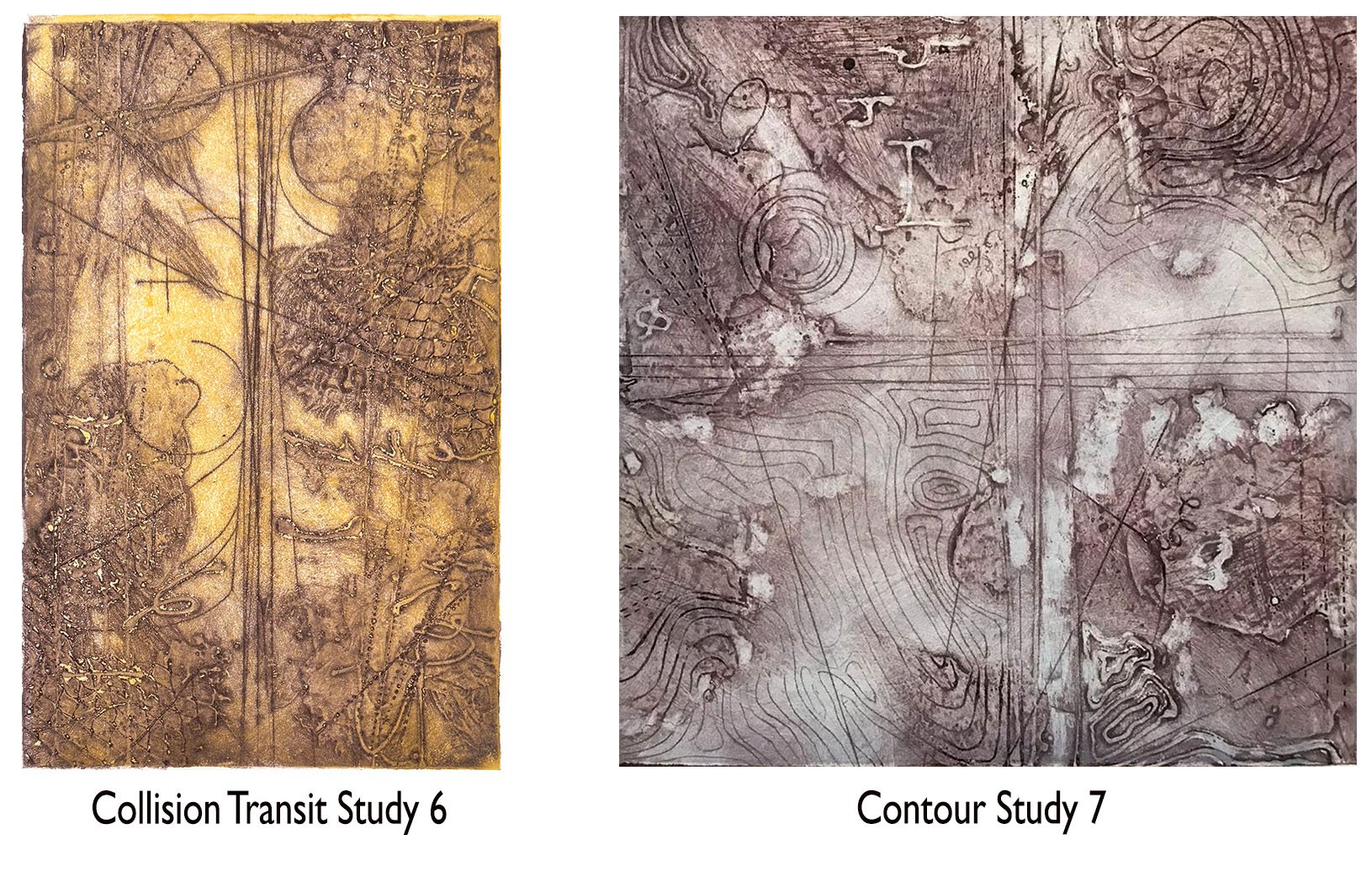
In Collision Transit Study 6, structural networks suggest movement across space. In Contour Study 7, (see images below) tonal strata evoke terrain and atmosphere. Together, they demonstrate the range possible within the encaustic collagraph process. View available works by Elise Wagner →
The Alchemy of Wax and Pressure
Encaustic has always carried a sense of alchemy. Heat transforms. Surface records touch. Transparency reveals depth.
In Wagner’s encaustic collagraph prints, pressure joins this transformation. Wax hardens. Ink settles. Paper yields.
The resulting works are quiet yet complex — structured yet atmospheric — embodying the dialogue between control and fluidity that defines her practice.
Through encaustic collagraph, Wagner expands the language of printmaking while remaining grounded in the physical intelligence of her medium. The prints are not merely images; they are surfaces shaped by heat, incision, and compression — an alchemy of wax and paper.
Structure and Movement: Collision Transit Study 6
In Collision Transit Study 6, Wagner’s interest in mapping systems becomes visually evident. Linear networks intersect and diverge across the surface, suggesting coordinates, trajectories, or navigational diagrams. Yet these lines are not mechanically rigid. Their irregularity reveals incision made directly into wax.
The tonal field surrounding these linear structures feels atmospheric rather than flat. Areas of density shift gradually into open passages. Subtle wiping variations create depth that recalls the translucency of encaustic painting.
What distinguishes this print is its balance between structure and movement. The incised lines anchor the composition, while layered tonal passages create spatial ambiguity. Light interacts with the surface differently across recessed and raised areas, activating the paper itself.
The work exemplifies how Wagner’s encaustic collagraph process merges drawing, painting, and printmaking into a unified visual language.
Ancient material, contemporary abstraction.