David Smith-Harrison - prints and biography
Contemporary Printmaker Exploring Architecture and Landscape as Quiet, Enduring Presences

By: David Smith-Harrison
Medium: etching and aquatint, printed to edge of sheet with deckled edges
Year: 1997
Edition of 135
Image Size: 16 inches X 12 inches
La Puerta III is a mixed-media intaglio print by David Smith-Harrison, depicting a palm tree rising above a finely rendered Spanish architectural gate set within a softly suggested landscape. The composition combines precise linear intaglio work with a warm watercolor wash and subtle pencil embellishments, lending the image both structure and atmosphere. The palm—isolated and monumental—serves as a vertical counterpoint to the classical symmetry of the stone gateway below, while faint mountainous forms recede into the background. Smith-Harrison’s integration of architectural detail and natural imagery reflects his interest in historical European settings interpreted through a contemporary printmaking sensibility.

By: David Smith-Harrison
Hand colored Intaglio
Medium: (hard ground etching and aquatint)
Image size: 7.5" x 5.5"
Paper size: 13" x 11"
Printing element: 1 copperplate
Edition Size: 135
Price: $500

By: David Smith-Harrison
Medium: drypoint on plexi
Imagesize: 9.5 inches X 8 inches
Papersize: 17 inches X 14 inches
Edition of 6
Year: 1987

By: David Smith-Harrison
Medium: etching and aquatint
Edition of 200
Paper Size: 7.75 inches X 17.5 inches

By: David Smith-Harrison
Medium: etching and aquatint
Year: July 2004
Paper Size: 26.5 inches X 33.5 inches
Image Size: 20 inches X 28 inches
A richly layered etching and aquatint that merges landscape, architecture, and memory. A leafless orchard stretches across the upper portion of the composition, its repeating rows of trees rendered with quiet precision and atmospheric depth. Beneath the field, a faint architectural elevation—suggesting a classical façade—emerges like a palimpsest, partially embedded in the ground.
Smith-Harrison’s combination of photographic imagery with etched line and tonal aquatint creates a dialogue between the natural and the constructed, the present and the historical. The winter orchard evokes stillness and passage of time, while the underlying architectural drawing introduces a sense of cultural memory and structure. The result is a contemplative work that reflects the artist’s ongoing exploration of place, history, and layered perception.

By: David Smith-Harrison
Medium: etching and aquatint
Year: 1996
Edition of 175
Paper Size: 36 inches X 30 inches
Image Size: 27 inches X 24 inches
Framed price: $3000
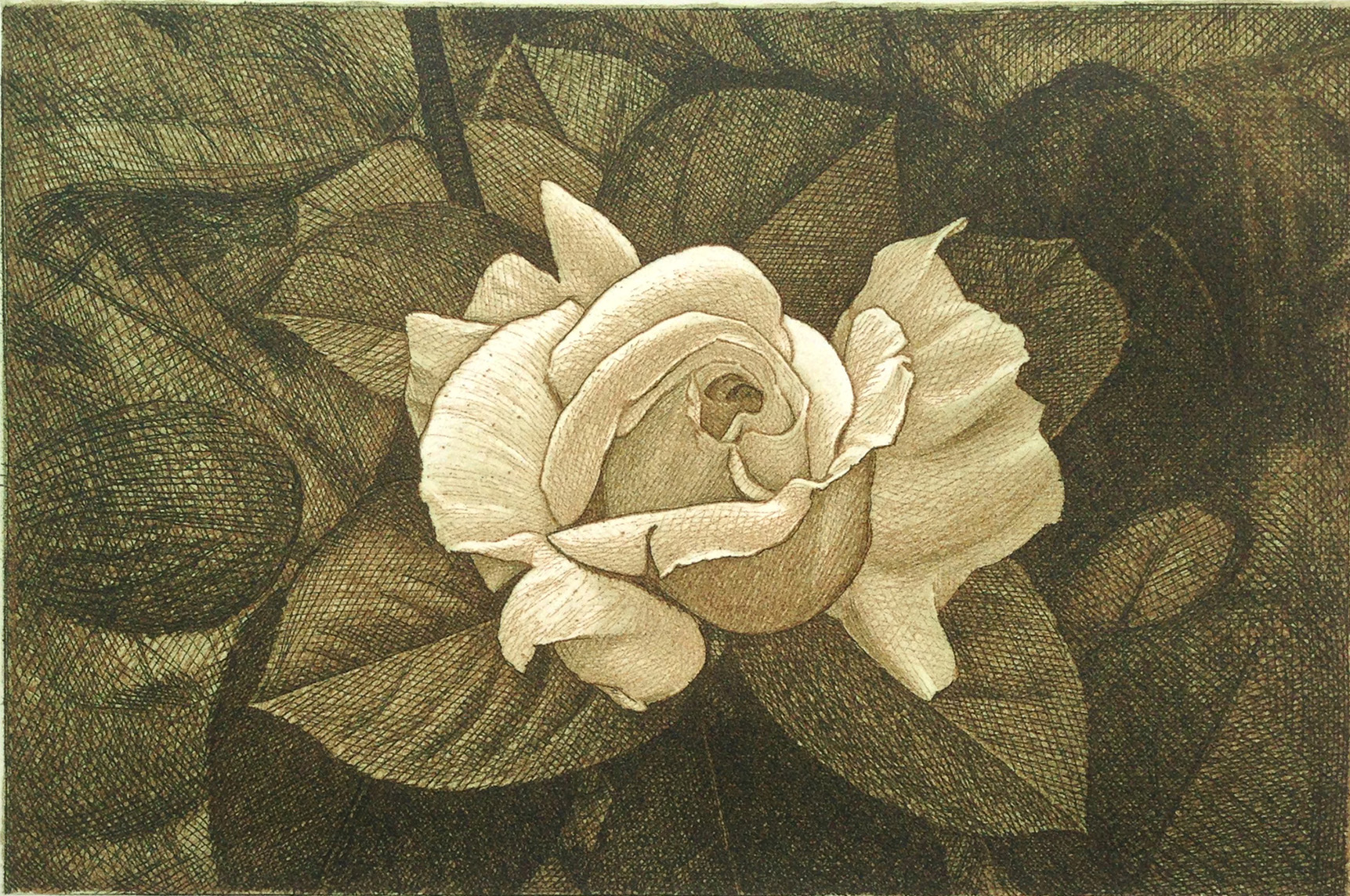
By: David Smith-Harrison
Medium: Hardground Etching and aquatint
Year: 2005
Projected Edition: 200
Image Size: 8" x 8"
Paper Size: 12 " x 11"

By: David Smith-Harrison
Medium: etching and aquatint
Year: 2004
Edition Size: 200
Paper Size: Somerset Satin White
Image Size: 4" x 6"
Paper Size: 11 " x 12"

By: David Smith-Harrison
Medium: etching and aquatint
Year: 2005
Projected Edition Size: 160
Image Size: 4.5" x 3.5"
Paper Size: 8" x 6.25"
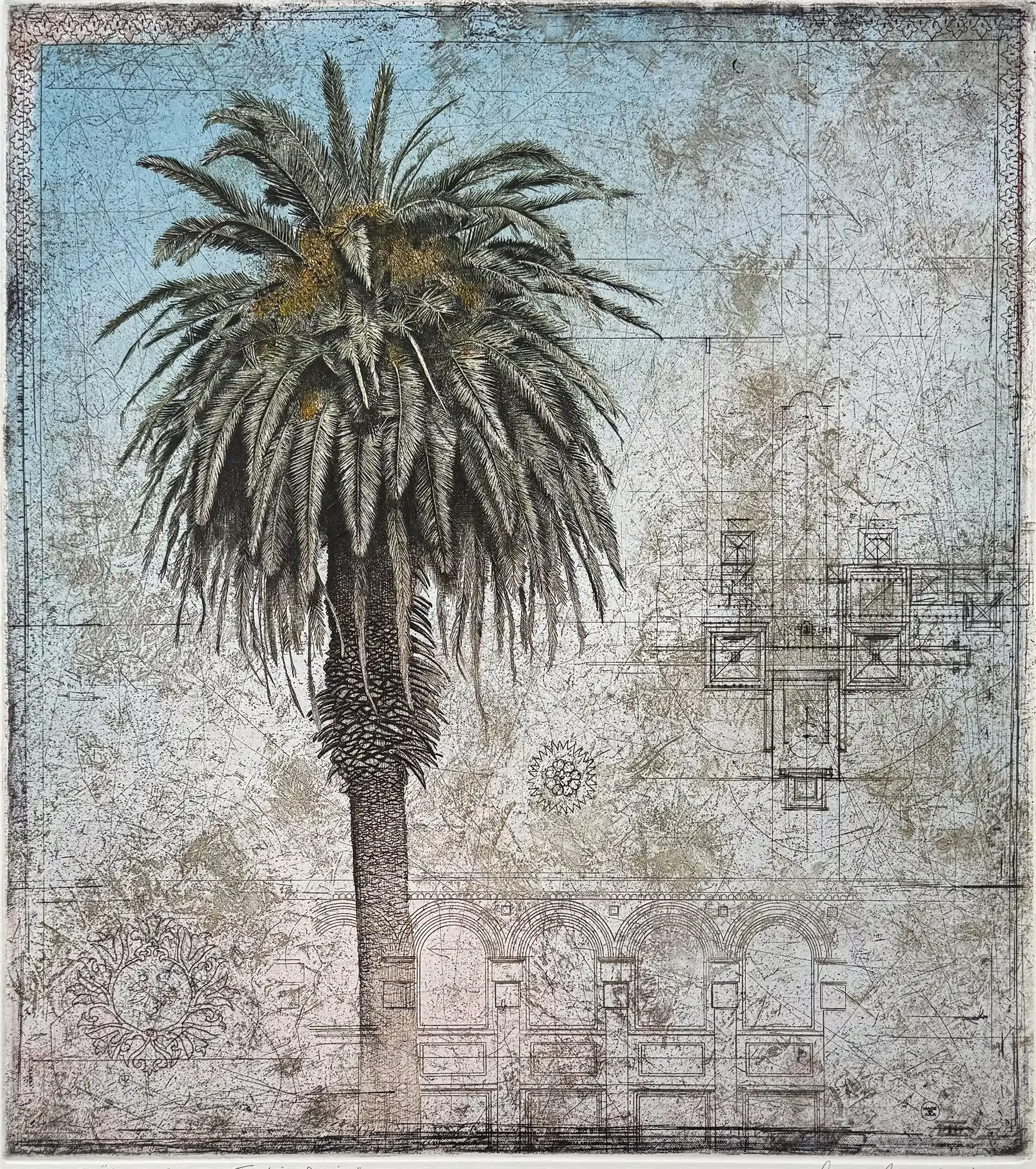
By: David Smith-Harrison
Medium: etching and aquatint
Year: 1988
Paper Size: 22 inches X 26 inches
Image Size: 18 inches X 16 inches
Like much of his work, Royal Palm has atmosphere of the Mediterranean, but all of the elements are rooted in the artist's neighborhood. The arches along the bottom of the print are from the façade of the Barker Building in Berkeley. The floor plan in the center right is is a reference to Charles A Platt: the Artist as
Architect. It also contains drawings of a Mayan building and drawings by Frank Lloyd Wright.
Royal Palm with Turkish Design is an interplay between the architectural rendering and the modeled line work of the palm. The border in the upper half of the print features a pattern from an early Ottoman brocade.

By: David Smith-Harrison
Medium: etching and aquatint
Year: 1989
Edition of 125
Image Size: 12 inches X 8 Inches
Price on request

By: David Smith-Harrison
Medium: etching and aquatint
Edition of 145
Paper Size: 46 inches X 31.5 inches
Image Size: 36 inches X 24 inches

By: David Smith-Harrison
Medium: etching and aquatint
Year: 1997
Edition of 160
Paper Size: 11 inches X 12 inches
Image Size: 5.5 inches X 7 inches

By: David Smith-Harrison
Medium: etching and aquatint
Year: 1999
Edition of 160
Paper Size: 18 inches X 15 inches
Image Size: 9.25 inches X 8 inches

By: David Smith-Harrison
Medium: etching
Year: 1989
Edition of 125
Image Size: 12 inches X 8 Inches
Price on request

By: David Smith-Harrison
Medium: etching and aquatint
Projected Edition Size: 200
Image Size: 10 x 8
Paper Size: 19.5 x 15
Year: 2004

By: David Smith-Harrison
Medium: etching and aquatint
Edition size: 200
Image Size: 5.75 in. x 8 in.
Year: 2003

By: David Smith-Harrison
Medium: etching and aquatint
Editionsize: 200
ImageSize: 5.75 in. x 8 in.
Year: 2003

By: David Smith-Harrison
Medium: etching
Projected Editionsize: 200
Image Size: 3 in. x 3 in.
Paper Size: 5.5 x 6.5
Year: 2004

David Smith-Harrison
Biography
David Smith-Harrison is an American printmaker whose detailed etchings bring together trees, gardens, and architectural imagery. Born in Salt Lake City, Utah, in 1959, he studied at Utah State University, the South Glamorgan Institute in Cardiff, Wales, and the University of Utah.
Drawing is the foundation of his work. Through sustained observation, Smith-Harrison explores the shape of a tree, the texture of foliage, and the relationship between natural forms and built structures. His admiration for the draftsmanship of the Italian Renaissance informs his approach, while his subjects also draw on his own surroundings and experiences.
In prints such as Royal Palm with Turkish Design and Cotoneaster, carefully rendered plants appear alongside architectural details and decorative patterns. Other works concentrate on individual trees, orchards, or intimate garden subjects. These combinations give his prints a distinctive character, bringing precise description together with imaginative arrangements of space.
Smith-Harrison works extensively with intaglio techniques, including etching and aquatint. His multiple-plate color prints develop through successive layers, while hand coloring allows him to explore variations in color and mood. He describes printmaking as a gradual process through which close attention leads to a more personal understanding of the subject.
His work is held in collections including the Fine Arts Museums of San Francisco’s Achenbach Foundation for Graphic Arts, the Cleveland Museum of Art, and the
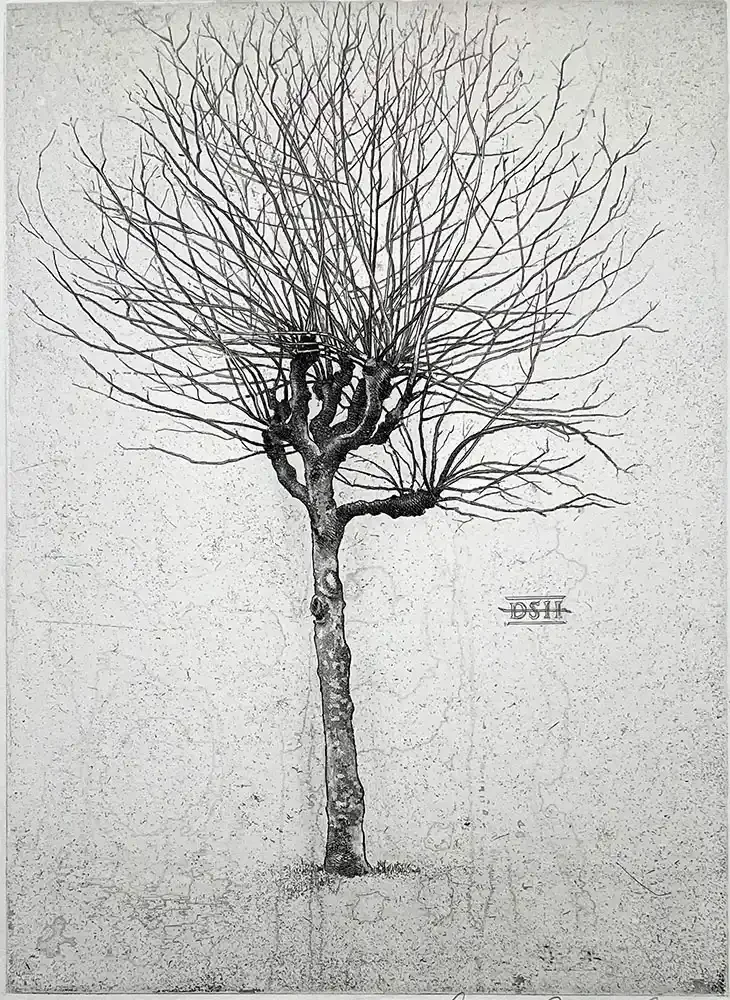
By: David Smith-Harrison
Medium: etching
Projected Edition Size: 135
Image Size: 7.5 x 5.5
Paper Size: 13 x 11
Year: 1998

By: David Smith-Harrison
Medium: etching
Projected Edition Size: 135
Image Size: 7.5 x 5.5
Paper Size: 13 x 11
Year: 1998

By: David Smith-Harrison
Medium: Unique hand-colored intaglio photogravure
Year: 2018
Edition: Unique
Image Size: 18 x 11.5 inches
Sheet Size: 23.5 x 16.5 inches

By: David Smith-Harrison
Medium: etching and aquatint
Year: 2003
Edition of 200
Image Size: 12 inches X 9 inches
By: David Smith-Harrison
Medium: 6 plate color etching and aquatint
Year: 2001
Edition of 135
Image Size: 18 inches X 16 Inches
Paper size: 26.5” x 22.5”
The architectural imagery in Cotoneaster is drawn from a niche on the south wall of the Great Mosque of Córdoba in southern Spain. Originally an Islamic landmark and later altered with Christian ornamentation following the Reconquista, the site reflects layered cultural and religious histories. The cotoneaster itself carries symbolic value, representing resilience, adaptability, and endurance.
View progressive proofs showing how Cotoneaster was built through successive printed plates.