Trevor Southey - prints and biography
Figurative Prints and Drawings Exploring Vulnerability, Tenderness, and the Human Condition

By: Trevor Southey
Medium: etching
Year: 1985
Edition of 60
Image Size: 16 x 24 inches
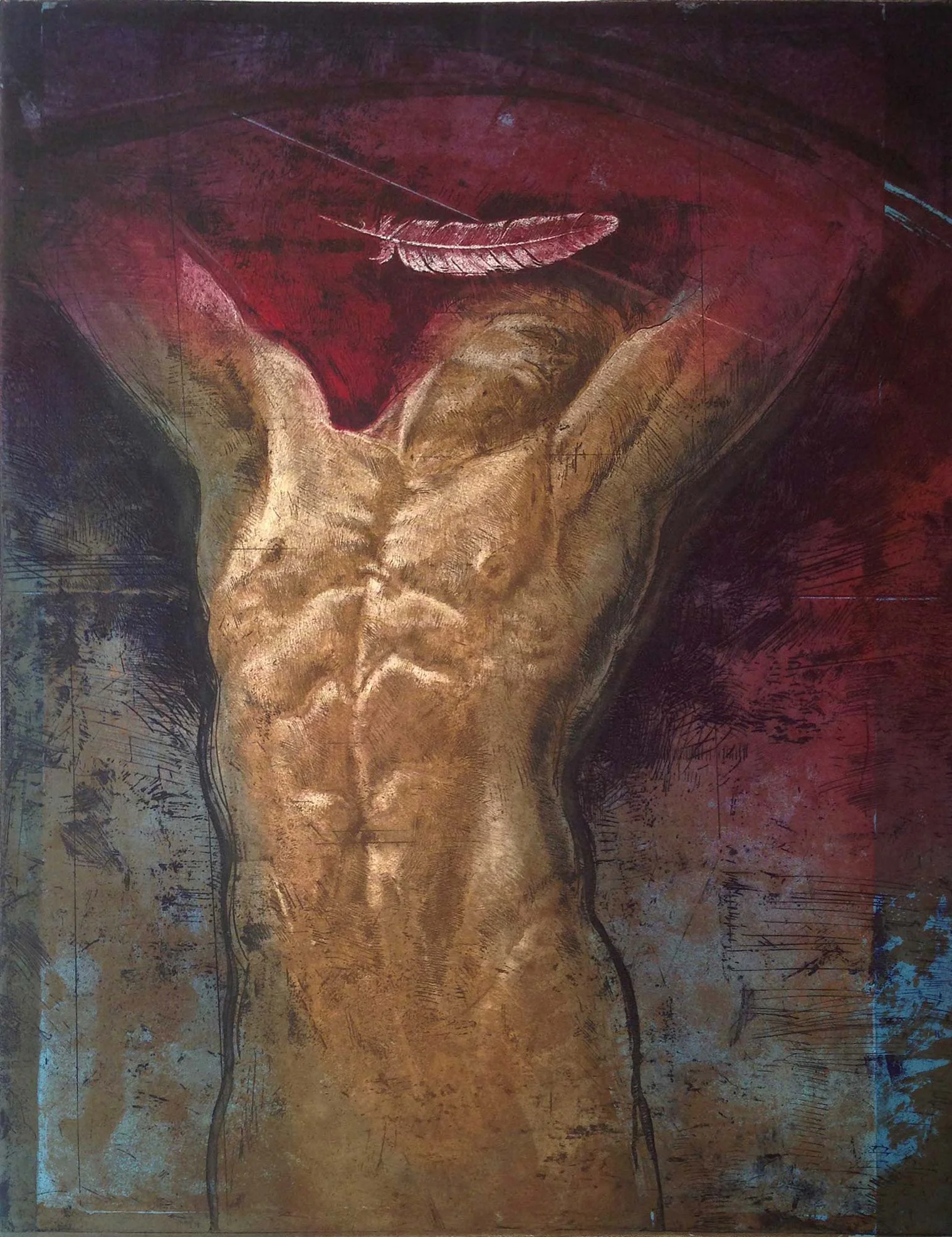
By: Trevor Southey
Medium: etching and aquatint
Edition of 100
Year: 1979
Image Size: 28 X 20 inches

By: Trevor Southey
Medium: lithograph
Year: 2002
Edition of 125
Image Size: H 36 in. x W 27.5 in.
Dominated by a deep, midnight blue, the composition is punctuated by vibrant yellow sunflowers—symbols of vitality and light—partially veiled in darkness. One sunflower is prominently lit, while another fades into the background, and a third appears only partially, as if slipping out of view. This progression suggests the passage of time or phases of transformation, echoing the natural phenomenon of an eclipse.

By: Trevor Southey
Medium: lithograph
Year: 1998
Edition of 150
Image Size: 22 X 32 inches
In Lifting, Southey renders the male nude with a blend of precise anatomical observation and expressive, gestural mark-making. The figure’s torso arches upward, arms extended, in a pose that suggests both physical exertion and transcendence. The composition combines richly textured areas of deep black with fluid, painterly sweeps of ink, evoking movement and vitality. Southey’s subtle tonal shifts and interplay between detail and abstraction invite the viewer to consider the emotional as well as physical dimensions of the human body.

By: Trevor Southey
Medium: lithograph
Year: 2002
Edition of 150
Image Size: H 22 in. x W 30 in.
Southey’s delicate use of color and painterly texture contrasts with the stark central void, inviting quiet reflection on the tension between presence and absence, the tangible and the eternal. a meditation on life, beauty, and the passage of time.
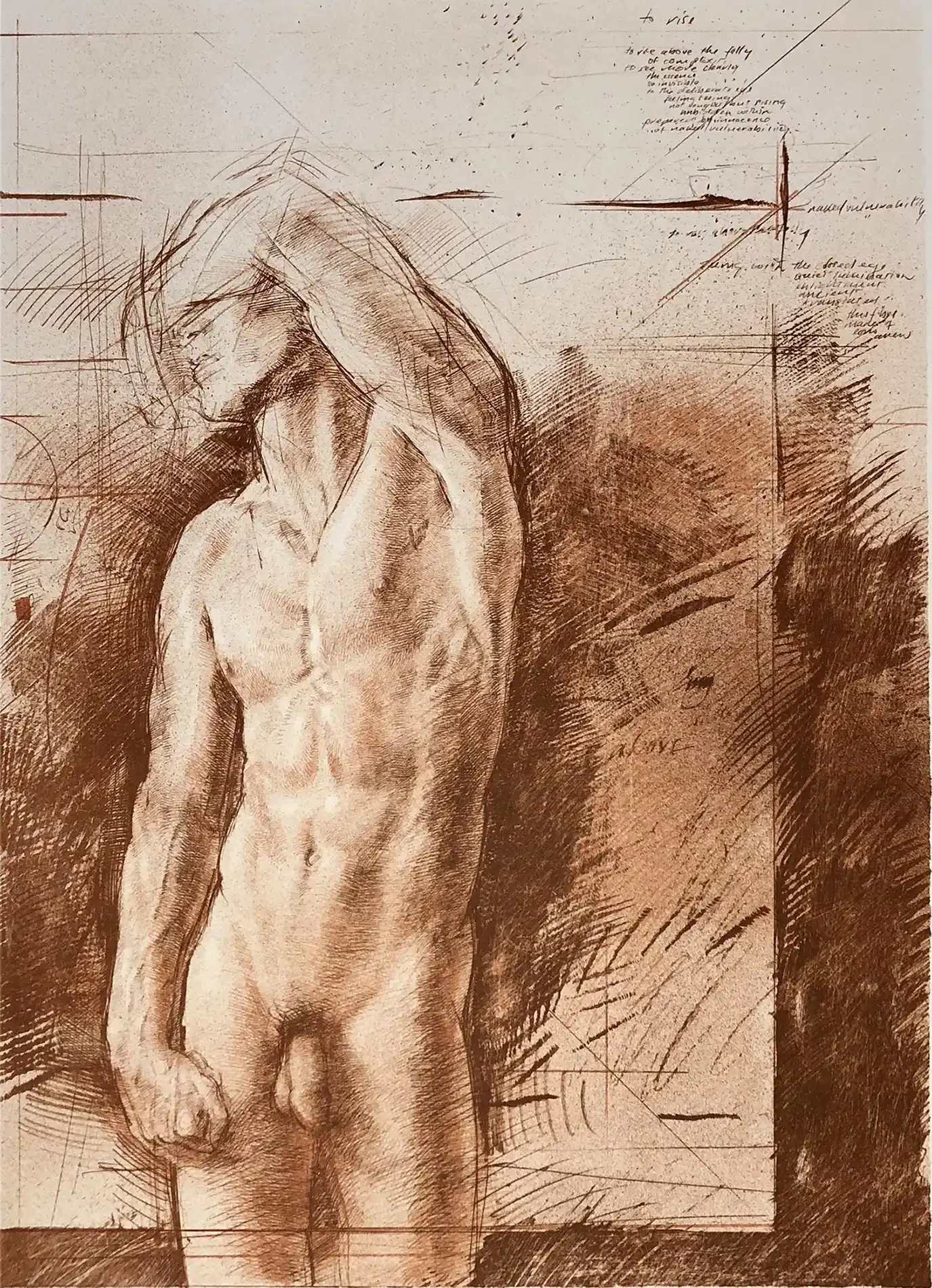

By: Trevor Southey
Medium: etching
Year: 1986
Edition of 100
Image Size: 8 x 6 inches

By: Trevor Southey
Medium: etching and aquatint
Year: 1986
Edition of 40
Image Size: 8 x 6 inches
Farm Eggs transforms an ordinary rural subject into a beautifully composed still life. Delicate etched lines describe the woven basket and straw, while soft aquatint passages model the eggs with remarkable volume and light.

By: Trevor Southey
Medium: etching and aquatint
Year: 1991
Edition of 125
Image Size: 15.5 x 10 inches

By: Trevor Southey
Medium: etching
Year: 1986
Edition of 100
Image Size: 8 x 6 inches

By: Trevor Southey
Medium: etching and aquatint
Year: 1986
Edition of 60
Image Size: 15.5 x 24 inches

By: Trevor Southey
Medium: etching
Year: 1989
Edition of 100
Image Size: 6 x 7 inches
Shirt is a finely observed etching by Southey, showing his meticulous draftsmanship and sensitivity to form. Here, Southey turns his attention to the humble folds of a garment, transforming an ordinary shirt into a study of texture, structure, and light.
Rendered with precise cross-hatching and subtle tonal gradations, the print captures the weight and drape of the cloth with remarkable realism. The creases and shadows invite the viewer’s eye to wander across the surface, evoking both the physicality of the textile and the human presence implied by its absent wearer. Southey’s background in classical drawing and his devotion to figurative realism infuse the work with quiet dignity, elevating the subject beyond the commonplace.

By: Trevor Southey
Medium: etching
Year: 1989
Edition of 100
Image Size: 6 x 7 inches

By: Trevor Southey
Medium: etching
Year: 1980
Edition of 50
Image Size: 8 x 6 inches

By: Trevor Southey
Medium: etching
Year: 1985
Edition of 100
Image Size: 6 x 8 inches
A quiet stone bridge crossing a narrow stream in a wooded landscape. Richly textured with expressive etched line work, the composition captures the peaceful atmosphere of the English countryside.

By: Trevor Southey
Medium: etching
Year: 1988
Edition of 160
Image Size: 8 x 6 inches
This evocative etching portrays a male nude seen from behind, his arm extended upward in a powerful yet graceful gesture. The figure’s musculature is rendered with classical precision, evoking Renaissance anatomical studies—particularly those of Leonardo da Vinci, subtly echoed in the faint sketches and mirrored writing that populate the surrounding space. Southey, known for exploring the human form through a lens of dignity, vulnerability, and spiritual searching, infuses this work with a sense of introspective strength. The upward reach suggests aspiration or transcendence, while the etched lines and textures blend precision with a dreamlike ambiguity, inviting contemplation on the human condition and our striving for higher understanding.

By: Trevor Southey
Medium: etching
Year: 1988
Edition of 160
Image Size: 8 x 6 inches

By: Trevor Southey
Medium: etching and aquatint
Year: 1988
Edition of 80
Image Size: 20.5 x 32 inches

By: Trevor Southey
Medium: etching
Year: 1982
Edition of 55
Image Size: 24 x 35 inches

By: Trevor Southey
Medium: etching
Year: 1988
Edition of 70
Image Size: 8 x 6 inches

By: Trevor Southey
Medium: etching
Year: 198
Edition of 100
Image Size: 12 x 11 inches

By: Trevor Southey
Medium: etching
Year: 2008
Edition of 150
Image Size: 12 x 18 inches
This portrait was done as part of a larger project titled Warriors for which Trevor traveled to Russia three times and produced 12 life sized paintings, a number of sculpture, drawings and etchings. As Trevor wrote about the project: “Nude, they cease to be Russian. The nudity deliberately chosen to suggest the sheer vulnerability of these specific people, their human being, their connection to ourselves… which so easily becomes hidden under the lie of the uniform making them anonymous and that much easier to kill.”

By: Trevor Southey
Medium: etching
Year: 1988
Edition of 150
Image Size: 8 x 6 inches

By: Trevor Southey
Medium: etching
Year: 1994
Editionof 150
Image Size: 8 x 6 inches

Trevor Southey
Biography
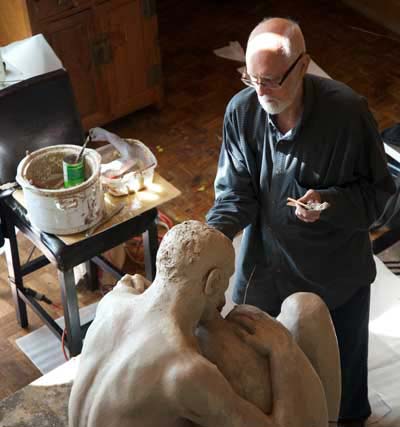
Trevor Southey (1940–2015) was a born artist and master printmaker whose work is distinguished by exceptional draftsmanship and a profound reverence for the human figure. Born in Rhodesia (now Zimbabwe) and raised in southern Africa, Southey’s early years were shaped by the expansive landscape and a deeply structured cultural environment.
After emigrating to the United States in 1965, Southey settled in Utah, where he became a central figure in the region’s arts community. Although geographically removed from the traditional centers of European classicism, his work remained deeply rooted in rigorous academic drawing. His figures possess a sculptural presence—modeled with sensitivity to anatomy, gesture, and light—yet they are never merely technical exercises. They are psychologically charged images of vulnerability, tenderness, resilience, and introspection.
Throughout his career, Southey repeatedly returned to the human figure, particularly the male form. His subjects often appear still or awakening, suspended in moments of reflection rather than action.
Southey also produced pastoral landscapes and symbolic works that reveal another dimension of his sensibility. Shepherds, fields, and quiet rural settings evoke a contemplative stillness. Southey’s classical approach places him in conversation with contemporary figurative artists such as Fernando Reyes, whose work likewise uses the body to convey longing, resilience, tenderness, and spiritual conflict.
His quieter landscapes resonate with those of François Houtin, inviting reflection through a shared attention to silence, atmosphere, and interior space.
His work has been widely exhibited and collected and continues to offer viewers a space for contemplation—where structure, memory, identity, and the human condition meet.

By: Trevor Southey
Medium: lithograph
Year: 1996
Edition of 150
Image Size: 13 x 16.5 inches
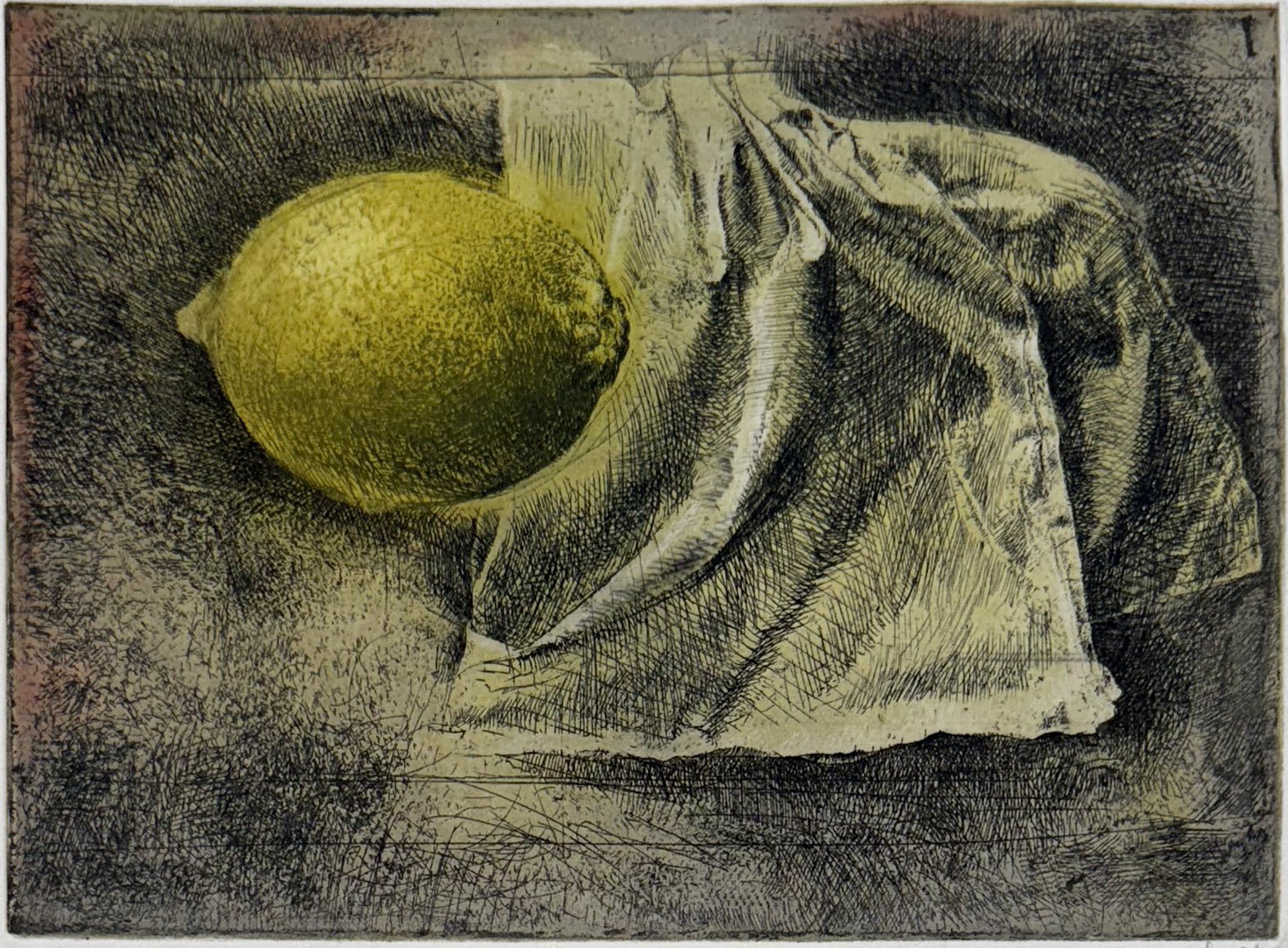
By: Trevor Southey
Medium: etching with hand-coloring
Year: Circa 1985
Edition Size: unknown
Image Size: 4.75 x 6.25 inches

By: Trevor Southey
Medium: etching and aquatint
Year: 1986
Edition of 75
Image Size: 9 x 14 inches

By: Trevor Southey
Medium: etching and aquatint
Year: 1986
Edition of 60
Image Size: 15.5 x 24 inches

By: Trevor Southey
Medium: etching
Year: 1988
Edition of 125
Image Size: 24 x 14 inches

By: Trevor Southey
Medium: etching
Year: 1981
Edition of 40
Image Size: 29.5 x 19 inches

By: Trevor Southey
Medium: etching and aquatint
Year: 1994
Edition of 100
Image Size: 8 x 6 inches

By: Trevor Southey
Medium: Etching
Year: 1986
Edition of 70
Image Size: 8 x 6 inches
By: Trevor Southey
Medium: lithograph
Year: 2002
Edition of 150
Image Size: H 22 in. x W 30 in.
Elegant calla lilies emerge with luminous clarity against a rich, textured maroon background. The geometric lines and faint mathematical notations etched into the composition suggest an underlying structure to the organic forms, hinting at the intersection of reason and emotion, science and spirit.