José Lozano

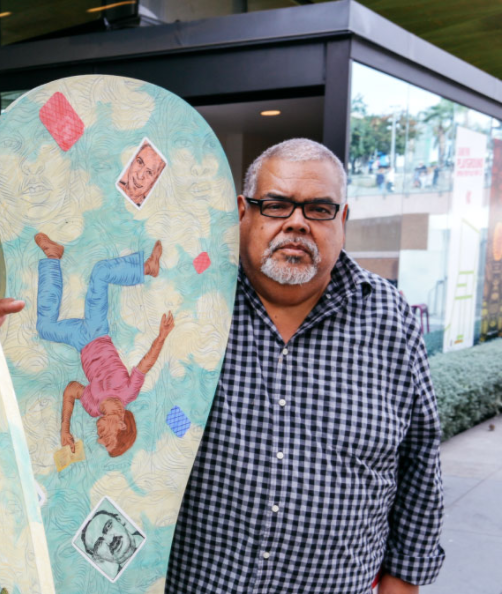
Jose Lozano
José Lozano (1959–2025, Los Angeles) was a celebrated painter, draftsman, and children's book author whose work is rooted in the cultural interplay between Mexico and Southern California. Born in Los Angeles and raised partly in Juárez, México, Lozano developed a visual language shaped by Mexican popular culture, everyday life, humor, and memory.
Lozano studied at California State University, Fullerton, earning both BFA and MFA degrees. His work has been exhibited at institutions including the Museum of Contemporary Art San Diego, UCLA Armand Hammer Museum, Orange County Museum of Contemporary Art, Self Help Graphics, and Avenue 50 Studio. He received a J. Paul Getty Mid-Career Grant in Painting and a California Arts Council Grant for Drawing and Painting.
A prominent figure in the Los Angeles Latino arts community, Lozano populated his paintings, drawings, and prints with distinctive characters drawn from observation, memory, cinema, and popular imagery. Crowds of faces frequently appear in his work, creating dense social environments in which individual stories seem to overlap.
His work is included in the Cheech Marin Collection of Chicano Art and other public and private collections. Lozano's combination of humor, cultural hybridity, and sharply observed human behavior established him as a distinctive voice in contemporary Chicano art.
By José Lozano
Medium: Screenprint
Year: 1991
Edition of 57
Image Size: 26 x 34 inches
In Hero, José Lozano presents a large masked face surrounded by a dense field of smaller faces and brightly colored, serpentine forms. The central figure suggests the visual language of Mexican lucha libre, but Lozano complicates the heroic image by filling nearly every surface with additional human faces.
The brilliant blues, pinks, yellows, and greens give the work an immediate graphic energy, while the repeated faces reward closer viewing. Lozano frequently drew upon Mexican popular culture, memory, humor, and the everyday characters of Los Angeles and the border region. Here, the masked protagonist becomes part portrait, part cultural icon, and part gathering place for an entire crowd.