Peter Milton - prints and biography
Narrative Etchings Blending History, Memory, and Imagination

By: Peter Milton
Medium: lift-ground etching and engraving
Edition: 15
Year: 1961
Plate: zinc 9 x 15 inches (22.9 x 38.1 cm)
Paper: Murillo, 16 x 21 inches (40.6 x 53.3 cm)

By: Peter Milton
Medium: Resist Ground Etching & Engraving
Edition of 250
Image Size: 9.5 x 12 inches
Year: 1993

By: Peter Milton
Medium: Resist Ground Etching & Engraving with direct photographic transfer
Year: 1975
Image Size: 19.63 x 31.75
Peter Milton’s Daylilies is a richly layered etching that explores memory, time, and the fragility of life. A solitary figure anchors the composition, surrounded by ghostly presences, portraits, and symbolic details that blur the line between reality and recollection. Milton’s intricate technique creates a dreamlike atmosphere where architecture, shadows, and figures overlap in a continuum of past and present.
The title evokes the fleeting beauty of daylilies, paired with “Limited” to suggest the constraints of time and mortality. Through this poetic imagery, Milton transforms personal reflection into a universal meditation on loss, remembrance, and the passage of time. Daylilies, Limited exemplifies the artist’s ability to turn etching into a vessel for memory — precise, atmospheric, and deeply resonant.
Milton gives a thourough description on his website at: Peter Milton Daylilies

By: Peter Milton
Medium: Resist Ground Etching & Engraving
Edition of 140
image size: 24 x 37 inches
Year: 2006
Peter Milton’s Hidden Cities: Continuum transforms the grandeur of the Galleria Vittorio Emanuele into a layered meditation on architecture, memory, and the passage of time. The Galleria, with its soaring glass dome and ornate ironwork, represents one of the great 19th-century triumphs of urban design: a covered arcade that merges commerce, leisure, and spectacle. Milton seizes upon this iconic site not merely as a piece of architecture, but as a vessel of continuity — a place where history folds into itself, where the elegance of the past reverberates within the modern city.
True to Milton’s style, the work does not present the Galleria as a straightforward depiction. Instead, he dissolves and recombines its elements, multiplying arches, corridors, and facades so that the viewer is drawn into a shifting labyrinth.

By: Peter Milton
Medium: Original Digital print
Edition of 75
Year: 2016
Image Size: 14.5 x 22 inches
Giardini Reali presents a nocturnal Venetian canal scene animated by shimmering reflections, drifting light, and the quiet movement of gondolas through darkened water. Peter Milton transforms the familiar atmosphere of Venice into a dreamlike psychological space, where architectural forms dissolve into mist, shadow, and reflected motion.
Originally developed from Milton’s earlier Aspern Papers drawings, the image combines the tactile qualities of graphite draftsmanship with the artist’s later digitally layered working process. The luminous surface of the water, softened tonal transitions, and cinematic spatial depth demonstrate Milton’s highly refined use of digital layering while preserving the intimate texture and atmospheric subtlety of the original drawings.
One of eight prints in this portfolio, Giardini Reali reflects Milton’s continuing exploration of memory, illusion, and layered visual space through contemporary digital printmaking.


By: Peter Milton
Medium: Original Digital Print
Edition of 75
Year: 2016
Image Size: 14.5 x 22 inches
Piazza Di San Marco explores the reflective atmosphere of Venice through layered tonal veils and blurred architectural space. One of eight prints in this portfolio.
In revisiting his earlier Aspern Papers drawings, Peter Milton used digital layering techniques developed over a decade of work in Adobe Photoshop while remaining committed to preserving the tactile qualities of the original graphite compositions. He wrote:
“THE ASPERN PAPERS is a classic tale by Henry James of duplicity foiled and love denied. Taking place in Venice, this print version is a gleaned set of eight prints developed and further opened up from the earlier 18 drawings portfolio of 1990-92.
I was intrigued by the question of how the images might benefit from the highly refined layering approach I had been exploring from my decade's adventure of working with Adobe Photoshop. My challenge was to stay true to the touch and textures of the original graphite drawings, and to remain equally resistant to the more facile or pre-programmed filtering that can so often de-personalize an artist's intentions, as intriguing as those effects can be.”

By: Peter Milton
Medium: Original Digital print
Edition of 75
Year: 2016
Image Size: 14.5 x 22 inches
The Oval Portrait evokes the interior psychological atmosphere characteristic of Peter Milton’s later work, where memory, literature, and shifting light dissolve the boundary between physical space and imagination. A solitary figure seated beneath fractured window light appears suspended between presence and disappearance, while reflected patterns and softened architectural forms create a dreamlike sense of instability.
Developed through Milton’s digitally layered process, the image preserves the tactile tonal qualities of graphite drawing while expanding them through subtle spatial manipulation and atmospheric depth. The blurred edges, luminous shadows, and spectral overlays reflect the artist’s sustained exploration of visual ambiguity and emotional interiority.
One of eight prints in Milton’s Aspern Papers portfolio, The Oval Portrait combines literary reference, cinematic lighting, and refined digital construction into an image that feels simultaneously intimate, theatrical, and psychologically charged.

By: Peter Milton
Medium: Resist Ground Etching & Engraving
Edition of 175
Year: 1987

By: Peter Milton
Medium: Original Digital Print
Edition of 75
Year: 2008
image size: 23 x 36

By: Peter Milton
Medium: Resist Ground Etching & Engraving
Image Size: 22 × 396
Year: 1978
Edition: 160
Peter Milton’s Les Belles et la Bête: Before the Hunt shows his ability to weave together fantasy, art history, and the subconscious into a single intricate vision. The print stages a surreal mise-en-scène that recalls both rococo opulence and dreamlike theater. At the center, the “beast” reclines in a chair, surrounded by nude and semi-nude female figures who appear both playful and spectral. Around them, cherubic figures tumble through the air, horses gather at the edge of a balustrade, and architectural elements dissolve into natural scenery, all contributing to an atmosphere of suspended time and heightened imagination.
Milton’s work often draws on literary and cultural sources, and here the reference to Beauty and the Beast becomes a vehicle for exploring desire, myth, and transformation. The piece is less about telling a linear story than about creating a landscape of memory and myth where figures from different times and sensibilities coexist.

By: Peter Milton
Medium: Original Digital Print
Year: 2011
Edition of 90
- small: image 19 x 30 inches , paper 24 x 36 inches, numbered 1-45/90
- large: image 23 x 37 inches, paper 32 x 44 inches, numbered 46-90/90
ECLIPSE was born out of Milton's interest in the photographer Eugene Atget, and his fascination with c.1900 street photography of Paris. Work on the image went through many transformations until the focus finally settled on Atget's Paris street scene of a crowd watching the solar eclipse of 1912. It was two days after the sinking of the Titanic. The clock is announcing the two times of the two events on a single face.
In homage to Atget, Milton assembled other notable photographers associated with Paris. For those who like puzzles, there are various versions of Atget, CartierBresson, Brassai, Lartigue, and Stieglitz.

By: Peter Milton
Medium: Original Digital print
Edition of 75
Year: 2016
Image Size: 14 1/2 x 22 inches
In revisiting his earlier Aspern Papers drawings, Peter Milton used digital layering techniques developed over a decade of work in Adobe Photoshop while remaining committed to preserving the tactile qualities of the original graphite compositions. He wrote:
“THE ASPERN PAPERS is a classic tale by Henry James of duplicity foiled and love denied. Taking place in Venice, this print version is a gleaned set of eight prints developed and further opened up from the earlier 18 drawings portfolio of 1990-92.
I was intrigued by the question of how the images might benefit from the highly refined layering approach I had been exploring from my decade's adventure of working with Adobe Photoshop. My challenge was to stay true to the touch and textures of the original graphite drawings, and to remain equally resistant to the more facile or pre-programmed filtering that can so often de-personalize an artist's intentions, as intriguing as those effects can be.”
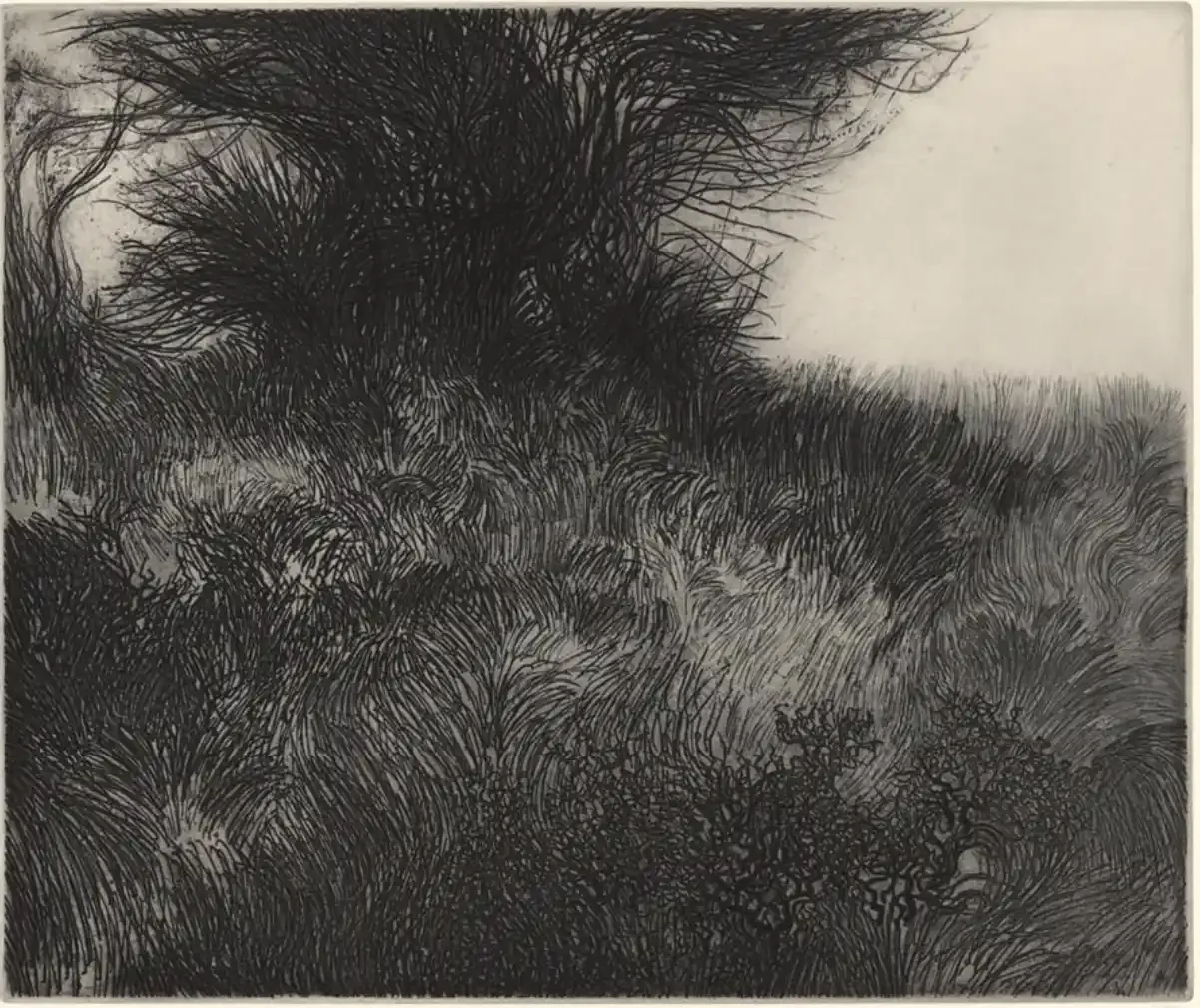
By: Peter Milton
Medium: Etching
Edition: 50
Year: 1962
Plate: 15 x 17.78 inches (38.1 x 45.4 cm).

By: Peter Milton
Medium: Resist Ground Etching & Engraving
Edition of 175
Year: 1999


By: Peter Milton
Medium: Digital print
Edition of 75
Year: 2011
Image Size: 19 x 30 inches

By: Peter Milton
Medium: Lift-ground etching
Edition of 35
Year: 1963
ImageSize: 17.5 x 23 inches

By: Peter Milton
Medium: Original Digital Print
Image: 32 x 44 inches
Year: 2009

By: Peter Milton
Medium: Original Digital Print
Edition of 90
Year: 2012
Image Size:
- small: image 19 x 30 inches, paper 24 x 36 inches, numbered 1-45/90

By: Peter Milton
Medium: Original Digital Print
Edition of 90
Year: 2014
Image Size:
- small: image 19 x 30 inches, paper 24 x 36 inches, numbered 1-45/90


By: Peter Milton
Medium: Lift-ground etching
Edition of 40
Year: 1962
Image Size: 14.875 x 17.875 inches


Peter Milton
Biography
Peter Milton (1930–2026) was one of the most accomplished American printmakers of his generation, celebrated for extraordinarily detailed etchings and engravings that combine history, memory, literature, and imagination.
Born in Pennsylvania, Milton studied painting at Yale University under Josef Albers before turning increasingly to printmaking in the 1960s. He developed a technically demanding approach to etching and engraving, creating densely layered compositions in which figures, architecture, landscapes, and historical references move between reality and dream.
Milton's prints are particularly known for their complex narrative structures. Figures from different periods coexist within invented spaces, while references to art, literature, music, and personal memory create images that reward prolonged viewing. His exceptional command of line, tonal range, and intricate detail made him an influential figure in contemporary printmaking.
His work is represented in major collections including the Museum of Modern Art, Metropolitan Museum of Art, National Gallery of Art, British Museum, Bibliothèque Nationale de France, Philadelphia Museum of Art, Fine Arts Museums of San Francisco, Los Angeles County Museum of Art, and Museum of Fine Arts, Boston.
Peter Milton died on March 12, 2026, at the age of 95, leaving a remarkable body of work created over more than six decades.
Related artists working with narrative and symbolic imagery:

By: Peter Milton
Medium: Resist Ground Etching & Engraving
Edition of 125
Year: 1982

By: Peter Milton
Medium: Resist Ground Etching & Engraving
Edition of 125
Year: 1982

By: Peter Milton
Medium: Resist Ground Etching & Engraving
Edition of 125
Year: 1982
By: Peter Milton
Medium: Resist Ground Etching & Engraving
Edition Size: 17
Year: 1994
Peter Milton’s Mary’s Turn reimagines a scene where Mary Cassatt and Edgar Degas engage in a game of billiards, reflecting their real-life friendship and rivalry. Cassatt leans forward to take her shot, while Degas watches with quiet intensity. The richly detailed interior, filled with framed artworks, onlookers, and luminous floating spheres, creates Milton’s signature dreamlike atmosphere.
At the far right, the artist includes a subtle self-portrait, placing himself as both observer and participant in this imaginative tableau. Blending art history, narrative, and technical brilliance, Mary’s Turn exemplifies Milton’s ability to collapse time and space into a single, enigmatic vision.